
Eungella: Land of Clouds book out now!
The new Queensland Museum book Eungella: Land of Clouds is out now!
https://www.shop.qm.qld.gov.au/default/land-of-clouds-eungella.html
You can read about the Eungella Biodiversity Study here:
https://www.researchgate.net/project/The-Eungella-Biodiversity-Survey

Science @ SAFE now online
In late 2020 I participated in the Science@SAFE (Stability of Altered Forest Ecosystem) Project virtual conference:
“The Stability of Altered Forest Ecosystems Project has been running for ten years with generous support from the Sime Darby Foundation. The Science@SAFE 2020 virtual conference brings together the science and achievements of the past ten years. We look at our impacts, capacity building, new technologies, carbon and how this project has improved our understanding of oil palm dominated landscapes and the resilience of Borneo's forest ecosystem.” - SAFE PROJECT MALAYSIA.
It was great to be involved and hear about some of the findings from SAFE.
I talked about ecosystem resilience in a tropical landscape, summarising a handful of the many important results on ecosystem resilience from the SAFE project. The whole conference has been uploaded to Youtube (link below).
Here’s to 10 more years of research @SAFE!
- Louise
Walks in the woods; combining field site-scoping and Saturday-afternoon saunters - By Brinna Barlow.
After 2020 caused a severe dearth of data collection and general PhD progress, we members of the BiodiversityAfter 2020 caused a severe dearth of data collection and general PhD progress, we members of the Biodiversity and Ecological Change lab are keen to get out and scope sites before March; when we will begin this year’s data-drive in earnest. This past Saturday (23.01.2021) three of us ventured into the New Territories to visit as many Fung Shui Woodland (FSW) sites as we could, all along Lam Tsuen valley.
The first we visited was long and narrow, wedged between farmland and the village proper. The next was mostly removed for an outdoor adventure camp and surrounding car park. Though here we did find three small shrines to the Goddess of Mercy, Guan Yin (觀世音 or 观世音, “[The One Who] Perceives the Sounds of the World”) as well as two small bomb shelters; remnants from World War II. Both of these were free of any sort of rubbish or other human-made debris, I spoke about how in the UK it would be filled with rubbish (and was provided evidence of this when a friend sent me a video of a British pill-box which was home to piles of empty cans and other less mentionable litter) and we congratulated the people of Hong Kong for their cleanliness, which was short lived as you’ll read after this intermission.

Distraction #1 -Lam Tsuen wishing tree
The Lam Tsuen wishing tree is heralded as a top attraction in Hong Kong. The original tree is many years dead, as are several of its successors. The current “official” wishing tree is a handsome Bayan maybe 10m tall, cut in a bonsai style. It has 23 branches, which its plaque told us is symbolic of having “good fortune all through life”.
Tourists coming here write their wishes onto joss paper, attach them to oranges (currently plastic replica oranges) and try to toss them into a plastic wishing tree, which stands perhaps 20 metres from the bayan and is styled after the original tree (this is used to protect the actual tree following an injury to its predecessor in 2005). It is said that if your wish gets caught in the branches on your first throw that your wish will come true in the following year.
After enjoying the tree we gave some coins to our respective zodiac animal statues (as well as some extra to the Ox, who’s year will start next month) at the nearby offering-area and sat together to eat some fresh-baked bread (courtesy of Bartosz) and fruit.


Back on the FSW trail we were disappointed to see that our next stop was little more than a wooded rubbish tip, with everything from bicycles, to washing machines to endless bin-bags of mystery refuse. As we waited for an iced coffee at a café on the edge of the woodland we lamented people’s disregard for this otherwise lovely area and spent some minutes in our minds to redesign the car park, remove the rubbish and add quaint paths, benches, maybe a fountain and small shrines to this woodland. Our next stop was much the same, minus the café; a small scrappy wood littered with quite attractive large glass bottles and assorted car-parts. But it was across the road from a wonderful orchid showroom, which was filled with a colourful array of flowers ahead of the Lunar New Year, when orchids are an essential buy.


Finally, after a morning and most of an afternoon of disappointing woodlands, our next stop was just what we were hoping for. We traversed some home-farms, with clean, clear water flowing in the irrigation ditches beside us. Dodged a couple of loud village dogs and made friends with a couple more and headed up into some old-growth forest as the afternoon became golden. We followed a small path into the woodland, which, naturally, lead us to a grave (those living and walking in Hong Kong will know that at any point you can come across a grave whilst rambling in the hills). Downhill from here we found people-free, litter-free forest with old, tall, sturdy-looking trees: perfect for canopy work. Site one was GPS-tagged.

Distraction #2 -Rubbish bin haul
A friend and I coined the term “trash-panda-ing” after months of frequenting our dormitories clothes recycling bin to liberate worthy items. To trash panda is to raid bins in search of items of desire. As we were walking down the road from the fourth FSW site one family was having a house-clearing and plenty of treasurable items were being left on the pavement. This included some hand-knitted tops, which are far too precious to end up in landfill. We spent a good while pawing through the bags and left with a number of items of clothing, a mah-jong set and knitting supplies. Fortunately, at the next set of bins we came across we found a suitcase to put all this in.


As the sun was falling, we hauled our haul into a minibus to take us uphill to our sixth and final FSW site of the day. This was abutting an evidently affluent village and we appreciated the graffiti murals as we walked through. With our suitcase of bin-goodies stashed in some tall grass we carried on past more graves and into the woodland. Though initially we tripped on vines underfoot and caught spider webs on our faces, the woodland soon opened up and we walked on crunchy leaf litter through patches of wild coffee saplings. Another ideal site, with secondary forest rising on the hills above the FSW and ancient camphor trees nestled at the edge of the village below. We GPS-tagged site number two and took a moment to throw our arms around the largest of the camphor trees and wonder how many ecologists it has suffered in all its long years.
Call for papers!
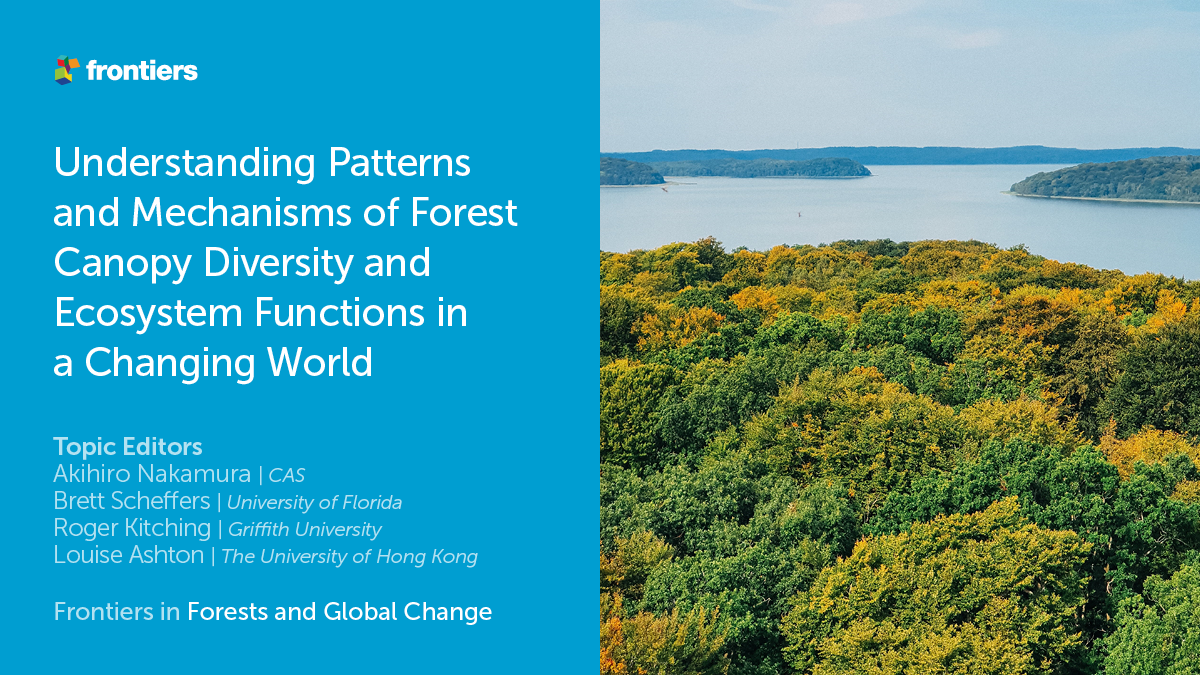
The canopy is the defining component of any forest ecosystem. The canopy, however, is not readily accessible and progress in understanding the ecology of forest canopies has been limited. With increased research interest combined with new technologies there have been recent advances in canopy science.
Despite substantial advances in our understanding of canopy ecology, many critical knowledge gaps remain. Forest canopies form vertically stratified ecosystems, but we know little about the vertical stratification of microclimate, species and genetic diversity across multiple scales. We must engage observational and experimental approaches to better understand the mechanisms that form verticality in diversity and ecosystem processes. This Research Topic will cover a wide range of topics associated with microclimates, microhabitats, biodiversity, ecosystem processes and their interactions among forest canopies. The studies presented will showcase our advances in canopy science ahead of the 8th International Canopy Conference.
For more information: fro.ntiers.in/8zMW